
KARNATAKA
SAFFRON FARMERS ASSOCIATION
Together We Grow Gold
Home | About Us | Members | Training & Programs | Technology | Marketplace | Contact
Successful Saffron Cultivation
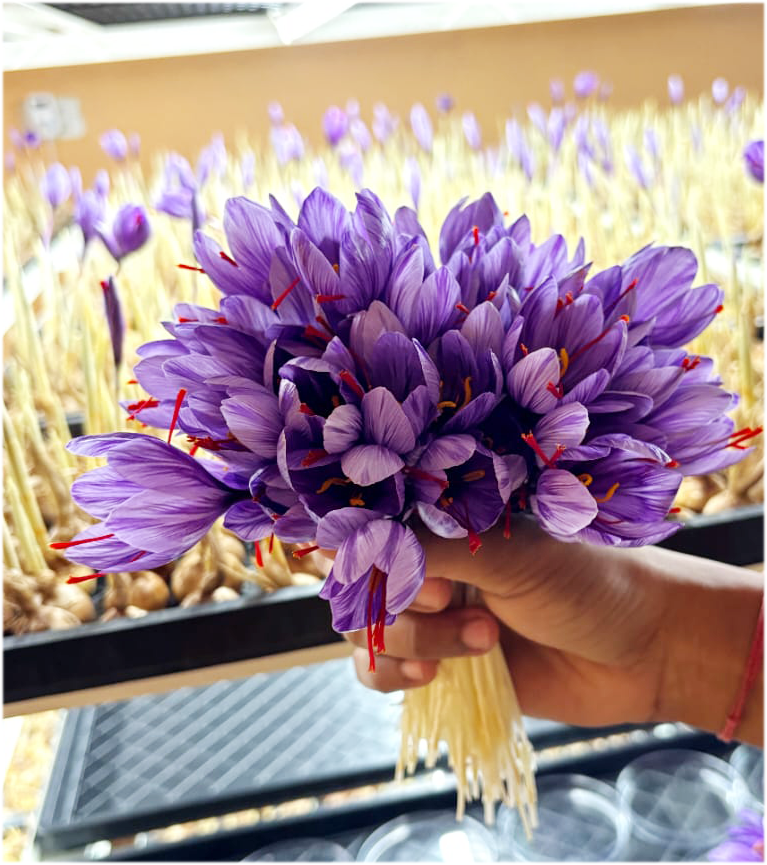

- Purpose of Fees
Fees are charged to ensure serious inquiries and to avoid non-serious or time-pass interactions. - Fee Distribution
- 80% of the fee is paid to the technical expert
- 20% is allocated for social and community development activities
Contact Number +91 9481916726
📝 Enrollment Process
📄 Fill the Application Form
📞 Call and inform KSFA before or after submitting the application
✅ Receive Confirmation Letter from KSFA
💳 Pay only after confirmation from KSFA
📜 Terms & Conditions – Saffron Farming Unit Setup & Corm Supply
Karnataka Saffron Farmers Association (KSFA)
(In collaboration with manufacturers, suppliers & partner institutes)
1. Scope of Service
- KSFA provides guidance, coordination, and support for saffron farming unit setup and corm procurement.
- Services may include vendor connection, technical suggestions, and setup assistance.
2. Nature of Involvement
- KSFA acts only as a facilitator between buyers, manufacturers, and suppliers.
- Final decisions regarding purchase, setup, and execution are the sole responsibility of the client.
⚠️ Important Declaration
KSFA IS ONLY A BRIDGE BETWEEN MANUFACTURERS AND SUPPLIERS. ANY CLAIMS, DISPUTES, LOSSES, OR DAMAGES SHALL NOT BE MADE AGAINST KSFA OR ITS MEMBERS UNDER ANY CIRCUMSTANCES.
3. Results Disclaimer
- KSFA provides technical guidance and best-practice recommendations for saffron cultivation.
- Crop yield, quality, and corm propagation outcomes may vary depending on environmental conditions, farm management practices, and individual implementation by the client.
4. Payment Terms
- Payments related to equipment, corms, or setup may be made directly to suppliers/manufacturers or as instructed.
- KSFA is not responsible for financial transactions between client and third-party vendors.
- Any service/consultation fee paid to KSFA is non-refundable.
5. Corm Orders
- KSFA may assist in identifying suppliers for saffron corms.
- Quality, size, and performance of corms are solely the responsibility of the supplier.
- KSFA does not take responsibility for corm failure, disease, or poor performance.
6. Unit Setup Responsibility
- Final execution of the saffron farming unit (economy/moderate/professional) is the client’s responsibility.
- KSFA provides only technical guidance and recommendations.
- Any issues related to construction, equipment, or performance are not the liability of KSFA.
7. Limitation of Liability
- KSFA, its members, and partners shall not be liable for any direct or indirect loss, including:
- Financial loss
- Crop failure
- Equipment malfunction
- Business loss
8. Client Responsibility
- The client agrees to:
- Verify suppliers before making payments
- Follow recommended practices properly
- Maintain proper environmental and operational conditions
9. Disputes
- Any disputes regarding equipment, corms, or services must be resolved directly with the respective supplier/manufacturer.
- KSFA will not be involved in legal or financial disputes.
10. Code of Conduct
- Clients must maintain professional communication and behavior with KSFA team, suppliers, and partners.
11. Amendments
- KSFA reserves the right to update or modify these terms at any time without prior notice.
12. Acceptance
- By proceeding with unit setup or corm order through KSFA, the client agrees to all the above terms and conditions.



📌 Scientific Fact
Saffron corm multiplication depends more on environmental stress balance than fertilizers. Too much comfort (water, nitrogen, humidity) actually reduces Flowers & propagation.
We provide only technical guidelines and advisory support for saffron cultivation and corm propagation.
Saffron is an agricultural crop, and all results—such as growth, flowering, yield, and corm multiplication—are entirely dependent on natural conditions, including climate, soil, water, and farm management practices.
No guarantee or assurance of results is given or implied.
By participating, the applicant/grower fully understands and accepts all risks associated with farming and agrees that no legal claims, disputes, compensation demands, or proceedings of any kind shall be initiated against us for crop failure, low yield, or any variation in results.
- MAIN REASONS SAFFRON DOES NOT BLOOM IN INDOOR FARMING
1. Wrong Temperature During Flowering Stage
Saffron requires a strict different temperature cycle:- Pre-flowering Stage
- Flower induction Stage
- Flowering Stage
If the temperature is too high or not stable, flower induction stops and no blooms appear.
- Excess Humidity in the Room
Indoor rooms with AC often have High humidity, but saffron requires low humidity before flowering.
If humidity is high, the corm will:
✔ rot
✔ produce leaves but no flowers
✔ remain dormant
Ideal humidity required for blooming: - Light Exposure Problems
Saffron requires a dark periodfor flower induction.
If light leaks or improper lighting cycles are used:
❌ Flower formation stops
❌ Corms go into vegetative mode - Overwatering or Moisture in Corm
Indoor saffron should not be watered before flowering.
If watered too early:
- Flowers do not form
- Corm gets fungal infection
- Nutrients shift to leaves instead of flowers
- Poor Quality Corms / Wrong Size
High-quality corms are the most important factor.
Problems when corms are:
- Below 20–25 grams
- Old or reused too many years
- Infected with fungus
- Not stored in correct conditions
Small or weak corms cannot produce flowers, even if conditions are perfect.
- Wrong Storage Before Indoor Planting
Saffron needs 60–90 days of proper dry storageat:
- Good airflow
- Zero moisture
If storage is wrong, the corm’s flower embryo does not develop — so it will never bloom.
- Insufficient Air Circulation
Closed indoor rooms without proper airflow cause:
- Ethylene gas buildup
- Fungal problems
- Stress to corm
- No flower development
Air circulation must be constant but gentle.
- Corm Planting Depth Issues
If corms are buried too deep or packed too tight:
❌ Heat cannot escape
❌ Moisture accumulates
❌ Flower bud fails to grow
Saffron prefersshallow plantingin indoor racks/trays. - Disease or Fungus
Fungal infections like:
- Fusarium
- Penicillium
- Rhizoctonia
These attack the corm internally and stop flowering even if the corm looks normal outside.
- Nutrient Imbalance Before Storage
Corms require a healthy growing cycle in the previous yearto generate a strong flower bud.
If nutrients were low last season, flowering will fail this season.
⭐ In summary:
Saffron does not bloom indoors mainly due to temperature mistakes, humidity issues, wrong corms, poor storage, overwatering, and light problems.